The Chromatic Composition Cube - An Initial Design Profile
I think building cubes is fun.
More accurately: I think coming up with cube ideas is fun. Sometimes all the joy is in tossing around the idea with others[1], idle Scryfall queries for what cards fit the terrible restriction I’ve just thought of, or partially filled-out or even complete cube lists kicking around on CubeCobra that probably won’t ever make the jump to physicality. But, well, with how many cube ideas I’ve been coming up with in the past year, it seems inevitable that eventually I would want to build another cube in paper. Honestly, this being almost a year after the first draft of A(n) Cube[2] seems like an act of restraint.
So: here’s all about the new cube, which I have dubbed the Chromatic Composition Cube!
The Initial Inspirations
A lot of the fun of designing new cubes is getting to play with new design ideas I haven’t had a chance to mess with yet. And this cube draws from a lot of different ideas I’ve heard and seen from around my play group and the broader cube design community.
Twoberts / Smaller Cubes
My local play group is at a point where sometimes we’ll have just a few attendees, and on other nights we are starting to push to the point where we might have more than eight. For both extremes, having a cube designed for a smaller amount of players, supporting up to 4 players instead of up to 8 players, seems nice to have. We obviously can play A(n) Cube and other larger cubes with a smaller number, but it can require adaptations to make things function better, like noting combo cards that won’t be in the draft or having to balance what lands make it in, and even without those can seem a bit overwhelming at times. That’s not a big problem or anything, but nothing like a bespoke experience only possible with the player count at hand. Plus, having to pick fewer cards to get to a full cube seemed nice.[3] I was pretty much completely convinced rather early on I wanted to build a smaller cube; all the rest of the design ideas shoved their way into that base concept.
Color-Restricted, Color-Imbalanced, and Semi-Desert Cubes
I’ve heard about a lot of various color-restricted cubes from various sources, like Ian Braverman’s Bant Cube from offhand mentions in his wonderful podcast Cuberviews, and the Gruul Cube and Golgari Cube up in Sonoma through Joe Anderson. I even got a chance to play one at California Cube Champs this past year: the Grixis Tresserhorn Gardens. Limiting what color cards exist in the cube is a rather straightforward restriction that leads to fascinating design and play spaces, and one I thought would suit a smaller cube. I’ve found that with 3 or 4 player drafts I’ve done in the past, people often find their color lanes pretty quickly and there’s not always a ton of overlap[4], or everyone is playing a lot of colors and the overlap is more incidental than competitive, which made drafts feel like they were lacking an element of intrigue. The idea of restricting the number of colors in the context of a smaller cube to force people to step on each others’ toes to the draft felt akin to reducing booster draft pack size. 15 card packs means for 8 players a pack will wheel a little less than 2 times, so to get a similar experience of how many cards wheel, for 6 players you can use 11 card packs. 8 players fight over 5 colors, so for a similar ratio of how many colors players can choose from you can have 4 players fight over 3 colors. However, while I liked existing color-restricted cube lists I found, in particular Jim’s Temur Twobert, I didn’t have a particular color combination that really intrigued me.
A different angle was also hooked into my brain: color-imbalanced cubes. On various cube podcasts I had heard about cubes, where certain colors are far more populous than others but all colors are still present somewhere, often being semi-desert cubes with a restriction of what basic lands are available. For example, the mostly Jund The Fire Swamp or the heavy black Pulp Noveau both only offer basic Swamps after the draft. I’m fascinated by how many colors people choose to play and when they choose to splash, so that space was also incredibly appealing. But again, while the idea of imbalance was interesting, choosing which colors were sparse or populous myself didn’t feel compelling.
Modular Cubes
Another space I’ve wanted to play around with is modular cubes, where there are different modules that can either replace part of or augment a base list of cards. The one I’m most familiar with is Changelings! (Theatrical Cut), a cube I based my initial 100 Universal Automata digital-only list on and have followed since. It intends to have other modules, or “cuts” as it calls them, that can be mixed into the base list, like the Community Cut of custom cards. I’ve yet to play a modular cube, but the concept gives me the same sense of intrigue and excitement as Jumpstart of meshing packages together to get something new, while also optionally giving some player agency in what kind of experience they want to have. Plus, smaller pods can often knock out a draft and games very quickly given there are fewer people and matches to wait on, so the idea of getting to have back-to-back drafts with explicitly different experiences with the same cube seemed especially appealing.
Rare Slot/Power Packs
Some form of rarity slot or power pack is something I’ve seen a lot in the latter half of the year: the Progressive Vintage Cube has themes to each of its packs, including one specifically for power, the Limited Cube had a unique rare slot card in a different sleeve in the midst of the standard-legal peasant cards comprising the rest of the pack, and Neon’s Conspiracy Companion Cube included a power pack woven in between the traditional draft rounds[5]. Maybe its the latent gambler in me, but I think seeing what rare card you got in your pack is extremely fun. Plus, the rare cards can often push you in a direction, whether that be the synergies it evokes or just the colors you need to cast it. I personally commit to draft lanes very quickly, which is brave of someone who doesn’t look at cubes beforehand to know what those lanes are, and a bit of pull in one direction or the other is nice.
Less-Good Fixing Lands
This one’s just for me. Through the process of building out A(n) Cube, I’ve developed a taste for some odd and some frankly below-par fixing lands. Having to figure out what lands you need to cast your spells is often a hallmark of desert cubes, but I feel like is underexplored in non-desert cubes[6]. But also, I feel like there are a bunch of fixing lands with neat effects and cool conditions that don’t necessarily get their time to shine. The land I were most interested in in the context of the cube was the lands that can potentially produce all 5 colors, but make you make a choice of which one you want. I, as aforementioned, am particularly fond of Jumpstart and the Thriving lands (e.g. Thriving Moor) contained within felt like a particularly clever way to anchor into a color but let you fix whatever other half-deck you ended up with. Night Market contained a similar decision point, but had the flexibility of cycling as well. From the Thriving lands I thought of the Vivid lands (e.g. Vivid Marsh), and I liked the balance of getting to get access to a needed color on the fly in contrast with needing to make a choice potentially in advance, but having two opportunities to do so seemed too powerful, especially with getting a colored pip for free. Instead, I opted for Tendo Ice Bridge, which gives you that same choice on an untapped land, but only ever once if you ever want a color. I felt like these could comprise an interesting land base, and I just needed to figure out how they could shine.
The Core Structure
The core structure of the cube emerged from that swirling pit of inspiration in a time of great stillness thought, and contemplation: while I was getting my hair highlighted. It was refined slowly and slightly over the course of subsequent weeks, mostly during my month and a half long cube hibernation, and emerged as thus:
Each color has 54 “base” cards and 9 “special” cards. Before starting the draft, all players will agree on which base colors will be used in this draft: these colors will make up the majority of the cards in the pool, and their corresponding basics will be the only ones available after the draft. Then, the special cards from the unchosen colors are added to the pool. The number of base colors chosen varies based on the number of players:
- For 4 players, 3 base colors are chosen. 3 colors x 54 “base” cards + 2 unchosen colors x 9 “special” cards = 180 cards, exactly enough for 45 cards per player.
- For 3 players, 2 base colors are chosen. 2 colors x 54 “base” cards + 3 unchosen colors x 9 “special” cards = 135 cards, exactly enough for 45 cards per player.
- For 2 players, 1 base color is chosen. 1 color x 54 “base” cards + 4 unchosen colors x 9 “special” cards = 90 cards, exactly enough for 45 cards per player.
From there, any draft method can be used; the card pool means standard booster draft of 3 pack by 15 cards will work, and so should pretty much any other method for small number of players.[7]
The Name and Theming
I had a mechanical structure for the cube I was very proud of for how cleverly everything fit together and its generic nature, but that generic nature meant I was rudderless on deciding what cards to actually fill that structure with. For that, I turned to the Lucky Paper Radio episode on resonance and the Lucky Paper article on aesthetics, and spent more deliberate thought than I normally do on naming the cube[8].
My A(n) Cube was named mostly thoughtlessly, but works well with a triple meaning: it is a cube I (An) own, the whole shtick of the cube is all of the card names containing “an”, and it is at its heart just “a cube” (or “an cube”, if you’re fine with odd indefinite articles[9]) without any special rules attached to the draft or gameplay. Those sorts of extra meanings is something I find personally appealing and wanted to be present here too.
The images that initially resonated with me for the cube were about stained glass; I think the image originated because of my love of stained glass in general, the Magic term “shards” for the allied color triads aligning with the shards comprising a work of stained glass, and listening to “What it Sounds Like” from “K-Pop Demon Hunters” on repeat. The idea of assembling colored pieces into a fuller image fit, but it didn’t quite capture the idea of picking and choosing which colors mattering. I played with some other ideas: spinning off “shards” into pottery “sherds,” something about a prism, etc.
Eventually, “composition” came to me as the most suitable. It captured that same element of what the cube was composed of being important, and also cast associations with where I most often hear the term: in music. If the cube is the composition, it places the players in the role of composers, and that nicely reflected the importance of the players’ role in selecting what colors go in. Plus, I had already been referring to the different card groups of a color as “base” and “special” cards, so the pun from “bass” to “bassline” flowed quite naturally and reflecting those cards being the underlying structure of a draft I was pretty sure I wanted this cube to be more synergy-oriented, too, so “melody” quite well described the sort of signpost guidance of a coherent experience I was imagining from the special cards. I added “chromatic” to reflect the central role color played in the cube, plus it ties into the music theming with the chromatic scale.[10] Adding “cube” to the end just made it all flow off the tongue better, and the alliteration is fun. Hence: the Chromatic Composition Cube!
I wanted to reference how this is a small cube in some way, but the name was already quite long and I couldn’t come up with anything I liked more. And, by the nature of its design, the whole thing has near as many cards as a traditional 8-player cube anyways (315 versus 360).
Some Additional Design Considerations
Now that I had a structure and a theme, I need to, you know, actually fill a list out with cards. I have a tried and true approach to building cube lists: scrolling endlessly on Scryfall. So I’m not immediately overwhelmed by the amount of cards I have to look at, I’ll often add some preliminary restrictions and considerations to limit the scope. Some other restrictions will arise organically from there as I narrow down what I want and don’t want, and those get tacked on to the end of the increasingly long search query. Some restrictions are just for enabling the creation of that initial list and will fade away; others are here to stay. But for this project, they all stemmed from the same three core design considerations:
- I want this cube to be distinct from my A(n) Cube so it fills a different niche that justifies why I would want to own it in paper and bring it to cube nights,
- I want this cube to have a coherent theming, and
- I want this cube to be as practical to exist in paper as possible.
Bar(-ish) Cube
Having no tokens or counters distinguishes this cube strongly from the A(n) Cube, where my love of token strategies dominates to the point of having over 50 unique tokens. Still, its only kind of a bar cube because there are some cards that require counters/some sort of visual indicators: the lands. I think the only external parts in the cube being color indicators for the lands really emphasizes the color-matters aspect to the cube; I have plans of creating such colored pieces myself out of air-dry clay as a fun little project. The biggest reason for this though is there are already quite a lot of moving parts to the cube: you need 5 distinct sections for the colors, and within those you separate out the bassline cards, the melody cards, and the basic lands for that color. Not having to juggle tokens and a lot of counters alongside that eases the part of my brain already concerned about how exactly I’m planning to store this.
Synergy
A(n) Cube is very good stuff focused; a lot of the fun is showing off the variety of cards that feature “an” in the name, mashing them together and figuring out how they work together. However, I’ve enjoyed cubes that lean a bit more heavily into strong synergy packages, and as aforementioned the bassline/melody theming lends itself to it as well. It also helped quite a bit with figuring out how to fill out the bassline cards with cards that are good role players but don’t necessarily overshadow the melody cards, so I could put together the list at all.
Rarity
This was the big restriction for getting the initial list created. I’m not at all concerned with rarity in A(n) Cube; I don’t think I could tell you what rarity any given card is there. However, I had already been thinking of the melody cards in terms of a rarity slot, and knew I wanted its effect to be on the more impactful side compared to the bassline cards to match the melody meaning. Taking cues from the Limited Cube, the only cube I’ve played with a similar rarity slot, I started with only common and uncommon cards as the bassline cards, and only rare and mythic rare cards as the melody cards, which really winnowed down the card pool to the point where I felt un-paralyzed by choice to create an initial list. This restriction something I’ve already broken, with an uncommon melody card in the form of Killian, Ink Duelist, but it did have the knock-on effect of there being no legendary bassline cards, which is something I’m planning on keeping.
Pip Density
This is actually something in common with A(n) Cube, just a lesson manifesting in a different way. The middling fixing in A(n) Cube means that multi-pip cards can be unexpxectedly taxing to cast. This is similarly a starting restriction: I have no idea how hard it will be to cast spells, so I opted for just one colored pip in all bassline cards and two colored pips in all melody cards to make it as easy as possible. It seems to fit with the idea of bassline cards being able to mesh pretty well and undergird most decks too, but this is something I’ll probably play with further down the line. Depending on how the lands configuration ends up, I might feel like I have room to put a bit more pressure on mana bases.
The Initial List
After the non-basic lands already mentioned, I started with selecting the melody cards. I knew I wanted the melody cards to act signposts of synergy, so I wanted to figure out what those synergies actually were. The most impactful card in shaping the initial list was definitely Baba Lysaga, Night Witch, a card I know from commander for caring about sacrifice and card types. Packing value into card types is a space I think is cool[11], and that seed of “card-types-matter” ended up lending itself to a lot of the other themes and matching melody cards: enchantress, historic, artifact creatures, delirium, threshold. Some of the other melody cards lent themselves to evergreen synergies I knew I could fill out with a wide range of cards: sacrifice, spellslinger, instants/flash, discard. But some lent themselves to more explicit themes: Human-typal, the menace and haste keywords. I tend to shy away from graveyard synergies as a player, so I shy away from it in A(n) Cube as well, so having it be more prevalent here opened up some cool cards. Plus, it let me put in Necrotic Ooze as the mono-black melody card, a creature I have fond memories of from seeing in creature combo lists and have never had a chance to take for a spin myself. I have no idea what you’re doing with it in this cube, but I’m excited to see people find out.
Needing nine melody cards to make the math work lent themselves to a pretty easy structure: 2 of each color pair that included the melody color, plus 1 double-pipped card of that color. Figuring out which color a melody card should be under, however, took a lot of brainpower. The general rule of thumb was that I wanted the melody card to be not in the color with most support, so there would be encouragment and support to splashing and leaning into that synergy. For example, the majority of enchantments are in white, so Sythis, Harvest’s Hand is a green melody card to encourage white decks splashing into green. Ideally the synergies will be a tad more evenly spread across all colors, so double off-color cards (e.g. Gruul cards in an Esper draft) are not quite as jarring with zero support, but that’s a longer-term goal once I nail down exactly what I want the melody cards to be. While I want the melody cards to shine, I also wanted payoffs within colors, so bassline strategies can theoretically stand on their own, so there are payoffs like Ethereal Armor and Zulaport Cutthroat within the bassline colors. I want to balance supporting the melody cards and having drafts feel like the choice of bassline colors matter to the cube experience and not just matter by proxy of what melody cards are available. I’ve leaned pretty heavily to the former for now because the bassline colors taking up so much of the pool feels like they should have impact naturally, but I can see myself need to tune this going forward.
Some themes I tried to seed in didn’t quite play out, most notably the go-wide strategy often centered in Selesnya or Boros. Without tokens, getting the creatures to go wide proved difficult. Still, I found manifest creatures and land creatures I found were cool ways to get extra board presence in such an environment. However, there are no board wipes currently, primarily due to their pip cost, and I found that after a few test drafts, akin to retail limited, to enable the synergies I needed to make the removal more expensive. I tried to seed in ways to evade and pump creatures, but I am a bit concerned about board stalls. The mana costs in this cube are quite low compared to A(n) Cube: the cards generally top out at 4 or 5 mana with plenty of 1 and 2 drops whereas in A(n) Cube I would say having and casting a 6-drop is realistic for most decks, in terms of the card pool and how long games go, so I could see things getting gummed up with a bunch of smaller creatures. We’ll see.
True to the color theming, I played with color-matters too, inspired mostly by Jim’s Temur Twobert. I have a fondness for these kinds of color-matters effects in limited doses that aren’t straight hosers, and I think the structure and theming of this cube means color-matters can shine in a really fun way. For example, the other bassline colors matter a lot for Wandering Champion, which can be easy or hard to trigger and the suite of landwalk creatures in green like River Boa can be lethal threats or underwhelming. However, notably missing is any protection or hexproof against certain colors, which I thought was less fun. The interaction gets some extra spice from considering their own color, too: Mystical Dispute gains value when you know just under a third of the cards will be blue spells, whereas the great rate of Sunlance looks a bit sketchier for the same reason.
Aesthetics
My A(n) Cube doesn’t not have a coherent aesthetic, but, uh, its aesthetic is “stuff I like and fits together in my eyes” which is perhaps not that coherent to anyone else. I was inspired to devote some time to building out a cohesive experience by my friend building out their own cube, Forgotten Monument, which incorporates aesthetic touches like expanding the black borders to mimic a claustrophobic cave system and using beads as life points to make gaining and losing life a tangible thing. I adore this small design stuff in general, especially in my data visualization work, so it was a delight to get to play with for this cube.
For this cube, I want the color to be the main focus, so I’m opting for only regular (e.g. no foil, no full-art) versions of cards, with no Universes Beyond cards as well to keep the focus away from any special treatments. Instead, I made my own special treatments by picking up a set of colored-border inner sleeves. Initially, it was a practical concern: with the melody cards comprised mostly of gold cards, I would need some way to tell if, say, Mirari’s Wake was meant to be slotted under white or green. However, upon trying out the sleeves, I like the border enough I plan to sleeve all the cards in their appropriate ones. It is very visually striking and reinforces the color theme, and I think having the melody cards stand out in a pack by the unique color will be a good effect. I plan to have the outer sleeves be gold, referencing Magic’s color shorthand for a mix of colors, but with a black interior so as to not draw focus from the colored inner borders.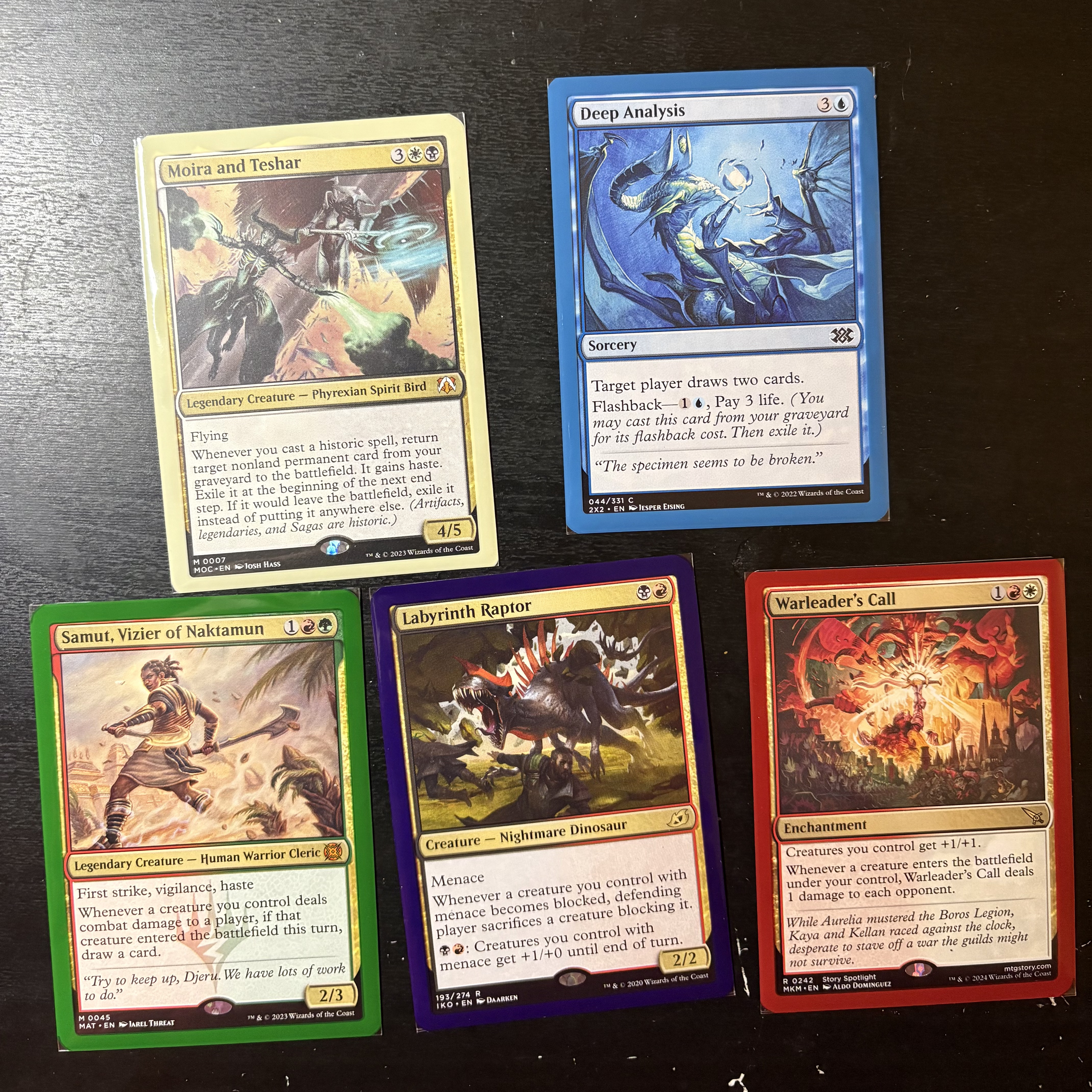
Similarly, I spent a good amount of time picking out the basic lands I wanted. My A(n) Cube has a deliberately mismatched aesthetic[12] with the end goal being to have full sets of unique full-art basics. Here, I wanted regular frame lands to match the regular frames of the cards, and for the color they represent to be particularly prevalent in the art. I figured it’d be easier for the lands to be coherent as a whole if they were from the same set, too. I ended up choosing a selection of basic lands from Core Set 2020 that should be relatively easy to get my hands on a set of.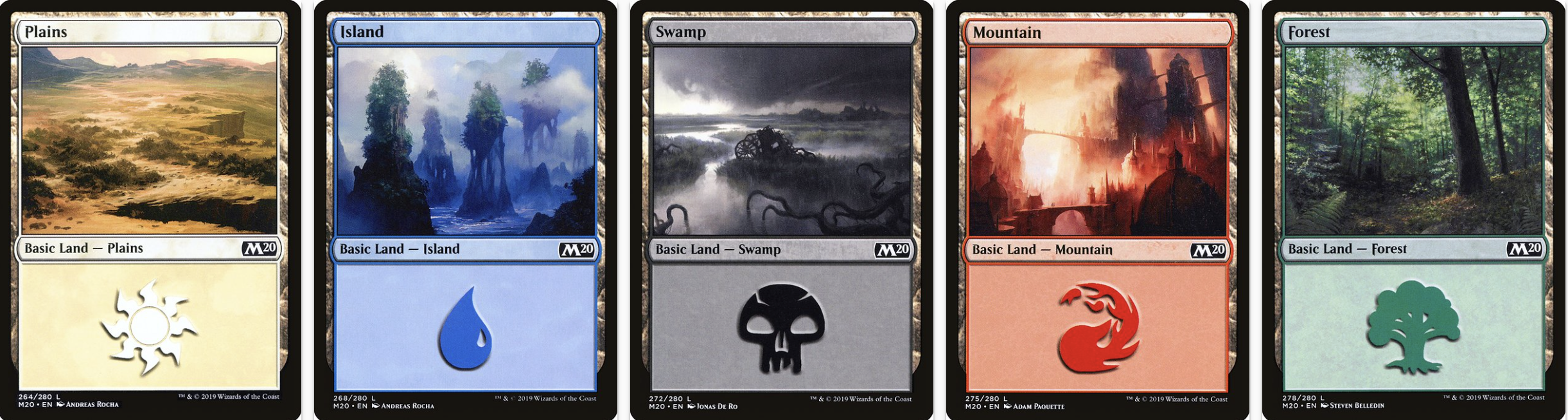
What’s Next
I’m now in the stage is getting the list in paper for the first few drafts! The key things I want to learn from the first few drafts are how drafters feel about the following things:
- the number and type of fixing lands - This shifted over and over again throughout my test draft process, as the lands I’ve chosen appear to be too low value for the CubeCobra bots and I was able to eat up a ton. The lands gain value from all being 5-color, but I’m not sure how many you will need to feel confident in splashing or going full multi-color, especially in a cube where basic lands are semi-restricted.
- the value of the melody cards - Are there some that were overly or not at all appealing? Would you pick it and try to build around it, or because it was just exceptionally good on rate?
- the various synergies - I want to know which synergies and themes players identify as existing in the cube at all, and which they identify as over or underpowered.
- the impact of the bassline colors - Does it feel like the base colors shaped the identity of the draft, or was it all just filler? Does an Esper draft feel like how you think Esper should feel, even with the melody cards?
I’m not exactly sure when it will get a spin, because we are getting more players consistently at cube nights, but not quite enough to require an overflow cube. Weirdly, though, this cube can play 2-4 players, as described, but also 7 players at once if the players are split into a pod of 4 and a pod of 3, with no overlapping bassline colors between the two pods (e.g. an Esper draft and a Gruul draft). So, we’ll see when we can take it out for a spin, but I’m very excited for then and the project as a whole.
Footnotes
The oops-all-alternate-win-conditions cube is definitely one of my ideas of all time, but I cannot be held reponsible for the suggestions to have infinite mana and infinite life as part of it. I do think the spinoff Transcendence cube, where you pick in advance what turn your Transcendence is going to come into play, might have some juice. It might be interesting as a bluffing board game rather than a Magic format, but still. ↩︎
I had to check the CubeCobra blog, but the first draft of A(n) Cube was on March 11, 2025. I’m guessing accumulating all the cards for this new cube is going to take a month or so, so it’ll probably make its draft debut 11 months later at the very earliest. A cube a year doesn’t feel like the worst pace, but also maybe not one I want to keep at a linear approximation. Logarithmic growth is a better target, probably. ↩︎
This, uh, didn’t quite hold true. ↩︎
This excludes the 3-player draft of A(n) Cube we did once where, by some possibly subpar shuffling, the front half of the draft was loaded with overwhelmingly just two colors of cards, and me and one of the other players were in those same two colors. The partially-open information nature of the Housman draft we were doing meant we knew we were fighting over the same colors too, and simply did it anyways. The third player very wisely, uh, picked some different colors, and profited when they all showed up near the end of the draft. ↩︎
I have contemplated putting Planequake into A(n) Cube as a way to get another pack in there, but the condition to get the booster pack is a little too egregious. ↩︎
Very possibly for good reason, but whatever. ↩︎
For 4 players, I’m a particularly big fan of what I call the diamond Housman draft, a variant of the Housman draft I learned from my local playgroup where you essentially do rounds of 2-player Housman drafts, alternating between drafting with the person to your left and the person to your right. The draft moves quite quickly because there are only 2 people involved in each draft round, and you often get a good sense what the players to your left and right will be playing and absolutely no idea what the person across from you is drafting, since you never draft with them. ↩︎
The title of this blog, for example, popped into my head while I was browsing potential website frameworks to build it with, and I thought “yeah, that sounds right” and didn’t think any more from there. I do think it works for a bunch of reasons, but all of those reasons were thought of well after the blog had already been named. ↩︎
At some point in my life, I’m going to commit the bit and use “an” as my sole indefinite article of choice. ↩︎
Fun fact: this cube was originally just called the “Color Composition Cube”; I had the idea to switch it to “Chromatic Composition Cube” while writing this article. ↩︎
Soul Transfer my beloved. ↩︎
I watched an episode of Say Yes to the Dress: Bridesmaids edition when I was young and the bridesmaid wanted bridesmaid’s dresses in unique styles but matching colors. This has lived rent-free in my personal taste since then. ↩︎